Sawyer Avenue, Sunday Afternoon
Inside an Immigration Arrest That Sparked a Neighborhood Protest
Originally published in The New Yorker on July 23, 2026.
Film by Bill Morrison
Text by Jamie Kalven
On October 12, 2025, during the Trump administration's immigration crackdown in Chicago known as Operation Midway Blitz, residents on a Northwest Side block witnessed federal immigration agents chase and detain a young Latino man outside their homes. As neighbors questioned the agents and documented the encounter, what began as a routine enforcement action became a remarkable record of community resistance.
Sawyer Avenue, Sunday Afternoon, directed by Bill Morrison and produced in collaboration with Invisible Institute, reconstructs the incident through witness cellphone footage, federal body-worn camera footage released through litigation, and investigative reporting. The film builds on Morrison and Jamie Kalven's Academy Award-nominated collaboration INCIDENT, continuing their work at the intersection of documentary filmmaking, investigative journalism, and public accountability.
Below is Jamie Kalven's accompanying essay, originally published by The New Yorker.
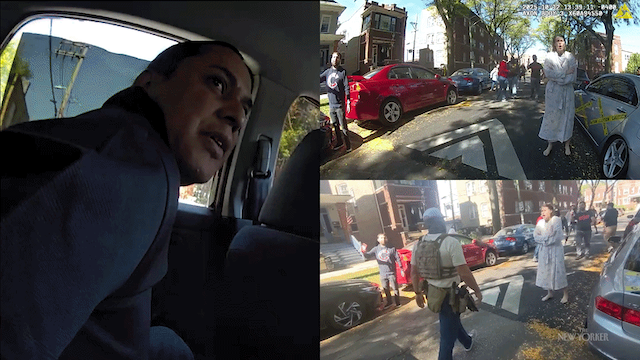
In October of 2025, during the Trump Administration's immigration crackdown in Chicago, dubbed Operation Midway Blitz, on a residential street in an ethnically diverse neighborhood, a young Latino man is chased and seized by masked Border Patrol agents. Most of the agents are young Latino men themselves, and appear to be at sea in the dense urban area. Neighbors emerge from their homes and pepper the agents—first with questions, then with invectives—and tensions quickly escalate.
Bill Morrison's short documentary Sawyer Avenue, Sunday Afternoon offers an inside view of this arrest, using videos shared by witnesses in the neighborhood as well as footage from the body cameras worn by the agents—we hear the protesters yelling, the agents strategizing, even the man being grabbed asking probing questions of those who have taken him into custody. The body-camera footage that shows all of this was made public because of a lawsuit filed last fall, in which a team of civil-rights attorneys sued the Department of Homeland Security alleging that the agency had violated the constitutional rights of protesters and journalists during Operation Midway Blitz. Federal District Judge Sara Ellis compelled the D.H.S. to submit relevant body-camera footage to the court and ultimately ordered the public release of the videos.
Body-camera footage is an essential tool for documenting law-enforcement encounters with the public and for countering false narratives. In 2014, I was the plaintiff in Kalven v. City of Chicago, in which the Illinois appellate court ruled that investigations of police misconduct are public information in the state. Invisible Institute, the human-rights reporting organization I founded, is committed to operationalizing transparency by making such information, long hidden behind a wall of official secrecy, useful to those seeking to hold government accountable.
We at Invisible Institute were moved to collaborate with Morrison in producing the film because of the immediacy of the incident it depicts: a community coming together to protect a vulnerable individual. This is not an organized protest. It is spontaneous and, on first impression, seems chaotic. Yet there is something elemental in the way the crowd unifies—like a flock of crows protecting their nests by raucously swarming a predator.
The combination of witnesses' videos, body-cam footage, and a C.B.P. incident report enabled us to identify several of the agents who were there that day. The body-camera footage serves both as an evidentiary record that may be the basis for future accountability and as part of a growing public archive, providing a revealing perspective on the dynamic of neighborhood-based resistance.
One of the people confronting the agents is a middle-aged white woman in a bathrobe and with bare feet, so outraged that she is propelled out her front door without forethought or time to put on shoes. She later told me she had never before in her life participated in a political protest, then added, "If I saw a child being kidnapped outside my door, and I stepped back inside and closed the door, who would I be?"
In June, Congress added seventy billion dollars to the D.H.S. budget, ramping up funding for Trump's mass-deportation-and-detention agenda, including the hiring of more agents. When the Trump Administration put U.S. Customs and Border Protection in charge of its crackdown in the country's interior, it erased the distinction between people who are caught illegally entering the country and those who have lived here for years or decades. Suddenly, the border was no longer just a geographic feature but something that cut across every dimension of American life
Credits
Directed by: Bill Morrison
Produced by: Bill Morrison, Jamie Kalven, María Inés Zamudio
Presented by: Hypnotic Pictures, Invisible Institute, and The New Yorker Documentary
Credit: The New Yorker